“The slow adoption of products like Salesforce’s Agentforce highlights a structural reality: AI cannot succeed when merely bolted onto systems built for record-keeping instead of real-time reasoning. As customer interactions accelerate, legacy CRM and CDP architectures—defined by fragmented data and siloed workflows—cannot deliver AI-native performance. What enterprises need now is a new foundation: a unified platform where data, semantics, decisions, and execution form one intelligent operating fabric. This is the promise of the AI-Native Customer Intelligence Platform—a system designed not to add AI, but to be AI at the core of enterprise operations.”
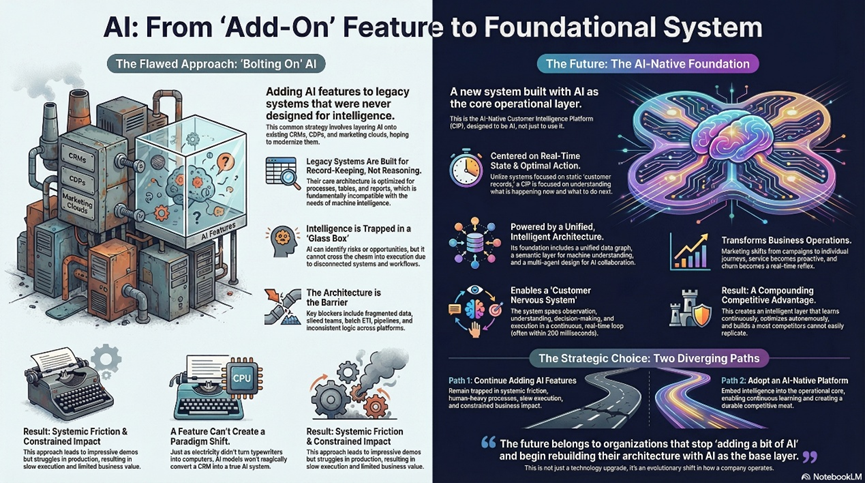
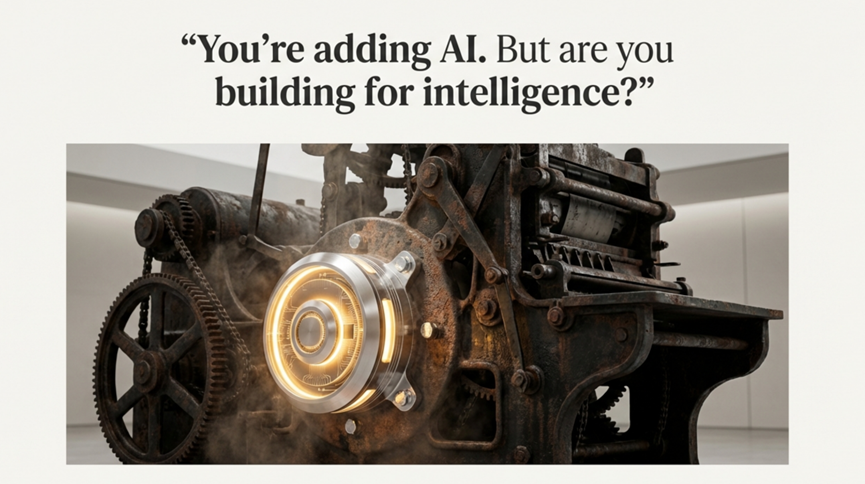
Over the past few years, nearly every enterprise undergoing digital transformation has walked the same path: move core systems to the cloud, then sprinkle AI features onto CRM, CDP, marketing clouds, and service platforms, hoping these small intelligent add-ons would breathe new life into aging architectures. Reality quickly pushed back. These AI features often looked impressive in demos but struggled to generate sustainable business value in production. Salesforce’s Agentforce, once positioned as a symbol of the industry’s transition into the AI era, found itself entangled in unexpected adoption challenges. This is not a product issue. It is a reflection of a broader strategic misstep: we have been trying to attach AI to systems that were never designed for intelligence in the first place. History teaches us that paradigm shifts are never achieved by adding features. The steam engine did not turn carriages into trains, electricity did not transform typewriters into computers, and today’s large language models will not magically convert CRM or CDP into true AI systems. Legacy enterprise systems were built for record-keeping—optimized around processes, tables, and reports—not for understanding, reasoning, or acting, which are the fundamental behaviors of machine intelligence. No matter how dazzling an AI feature appears, it remains a peripheral adornment floating above an old logic layer, unable to penetrate the operational core of the business.
The challenge enterprises face today is not a shortage of AI. It is the absence of an architecture that can actually host AI. Data remains fragmented across dozens of systems. Workflows are still linear, requiring human judgment to trigger each subsequent step. Teams remain siloed—marketing, service, product, and operations all use different tools that lack a shared semantic layer. Even when AI detects churn risk or identifies a critical behavioral signal, it struggles to deliver the right action to the right channel at the right moment. Intelligence becomes trapped in the insights layer, unable to cross the chasm into execution. The ability to see problems and the ability to resolve them remain perpetually disconnected.
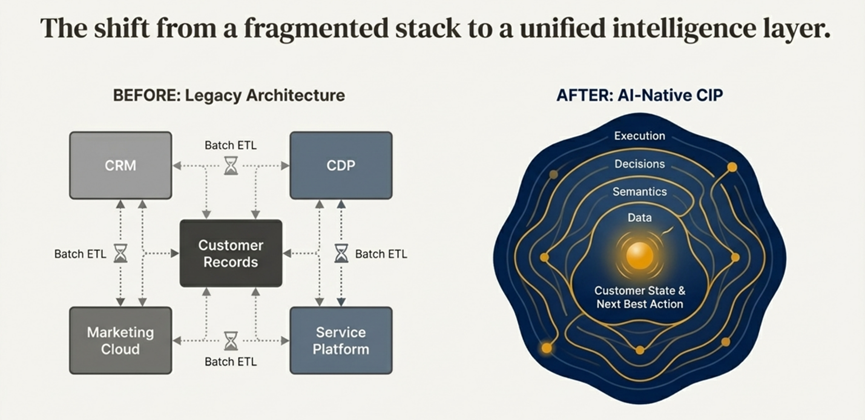
This is the fundamental structural reason traditional systems cannot usher enterprises into the AI era: the architecture itself was never built for intelligence. As long as the foundation relies on batch ETL pipelines, isolated schemas, inconsistent event sources, redundant metrics, and disconnected decision logic across systems, even the most advanced AI models will behave like voices inside a sealed glass box—reasonable, but impossible to operationalize at scale.
The real inflection point emerges with a new kind of system: the AI-Native Customer Intelligence Platform (CIP). Unlike systems centered on “customer records,” an AI-native CIP is centered on the customer’s real-time state and the optimal next action. Its foundation is a unified data graph; its semantic layer allows machines to understand the enterprise’s business language; and its multi-agent design enables different AI roles—those responsible for insights, recommendations, pricing, journey strategy, or compliance—to collaborate fluidly. They share the same customer context, operate within the same decision space, and drive actions directly into the channels where interactions occur, often within 200 milliseconds.
These are capabilities legacy systems cannot imitate because they were never designed for real-time processing, machine reasoning, or agent collaboration. An AI-native CIP gives enterprises, for the first time, a continuous intelligence layer that spans observation, understanding, decision-making, and execution. It no longer waits for marketing teams to export lists, product teams to interpret dashboards, or service teams to manually triage cases. Intelligence becomes woven into the business itself, enabling the company to operate with something akin to a “customer nervous system.”
Once intelligence shifts from a feature to a foundation, the nature of business operations changes. Churn is no longer a monthly metric; it becomes a real-time reflex. Marketing moves from calendar-driven campaigns to continuously evolving individual journeys. Service transforms from reactive support to proactive care. Product-led growth becomes guided by signals recognized by AI, timed precisely, and coordinated across teams. For the first time, enterprises can “think in parallel” across millions of customers, applying consistent logic, unified strategy, and auditable actions at scale.
This introduces a deeper strategic divergence for CIOs and CMOs: competitive advantage will no longer come from whichever tools an enterprise purchases, but from whether the organization builds an architecture where AI can actually operate. Over the next three to five years, the gap will become unmistakable.
Some enterprises will continue layering AI onto CRM and CDP, generating more intelligent-looking features yet remaining trapped in systemic friction, slow execution, and constrained business impact. Others will adopt AI-native CIPs, embedding intelligence directly into their operational core. The difference will be profound. The former will continue wrestling with fragmented systems and human-heavy processes; the latter will accumulate a compounding advantage—an intelligent layer that learns continuously, optimizes autonomously, and creates a moat that competitors cannot easily replicate.
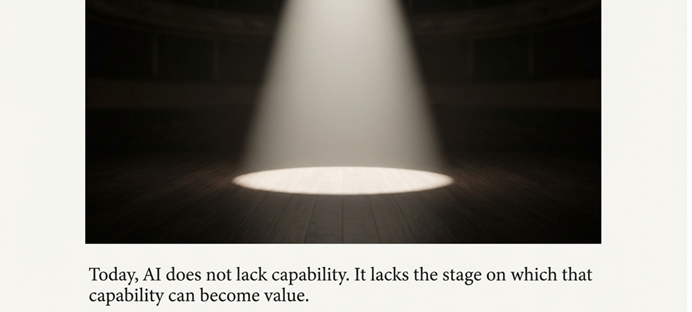
We often say AI will reshape enterprises, but whether an enterprise truly evolves has never depended on the power of the model itself. It depends on whether the organization can build a system where AI is allowed to matter. Today, AI does not lack capability. It lacks the stage on which that capability can become value. It lacks an enterprise nervous system that is no longer governed by tables, batch jobs, and manual connection points.
The future belongs to organizations that stop “adding a bit of AI” and begin rebuilding their architecture with AI as the base layer.
This is not a technology upgrade. It is an evolutionary shift in how companies operate.
And that evolution has already begun.
–Chunbo Huang 12/05/2025