For decades, the retail industry has chased the promise of seamless omnichannel experiences—only to be stymied by the limitations of legacy systems and siloed data infrastructure. What began as a vision of consistent, personalized customer journeys across online, in-store, and social touchpoints has too often devolved into disjointed campaigns, duplicate customer records, and teams trapped in manual data wrangling. Today, a paradigm shift is underway: the industry is moving beyond Customer Data Platforms (CDPs) to Customer Intelligence Platforms (CIPs)—and Socialhub.AI’s 5-layer CIP engine is leading this transformation, turning fragmented data into actionable, profitable omnichannel impact.
The Legacy Trap: Why CDPs Failed to Deliver on Retail’s Omnichannel Promise
Customer Data Platforms (CDPs) emerged as a solution to the chaos of siloed customer data, promising to aggregate information from e-commerce, POS, loyalty programs, and social channels into a “single view of the customer.” Yet for most retailers, this promise remained unfulfilled, as CDPs fell short in three critical areas that undermined omnichannel success:
- Data Silos Persisted: CDPs excelled at collecting data but failed to integrate it into end-to-end business workflows. Marketing, loyalty, and customer service teams were left with disconnected dashboards, unable to coordinate cross-channel campaigns or deliver consistent experiences. A global apparel brand, for example, found that 35% of its customer records were duplicated across regional systems, requiring months of manual cleaning before any meaningful analysis could begin.
- No Native Business Logic: Legacy CDPs treated data as a static asset, not a dynamic foundation for retail-specific rules. Brands were forced to build manual workarounds to enforce loyalty tiers, regional compliance, and promotion guardrails—creating operational bottlenecks and compliance risks. A premium F&B chain attempting to launch a cross-border promotion discovered its CDP could not enforce regional age restrictions, putting the brand at risk of regulatory penalties.
- AI Was an Afterthought: Most CDPs lacked native AI capabilities, requiring retailers to bolt on third-party tools for personalization and predictive analytics. This created a patchwork of systems that were slow to deploy, difficult to maintain, and unable to deliver real-time insights at scale. A U.S. beauty brand spent $2M on a “personalization engine” that still required 10+ manual steps to launch a simple recommendation campaign, delaying time-to-market and eroding ROI.
The result? Disjointed customer journeys, missed cross-sell opportunities, and teams spending more time on data reconciliation than on strategy. Even well-funded omnichannel initiatives delivered little measurable growth, as legacy systems proved incapable of turning data into intelligent action.
The Evolution: From CDP to CIP — Socialhub.AI’s 5-Layer Engine for True Omnichannel
Socialhub.AI’s Customer Intelligence Platform (CIP) redefines retail’s data infrastructure with a 5-layer architecture that unifies data, business logic, AI, and workflows into a self-driving system. Built from the ground up for retail, this engine solves the core limitations of CDPs, enabling end-to-end omnichannel success. Let’s break down each layer and its real-world impact:
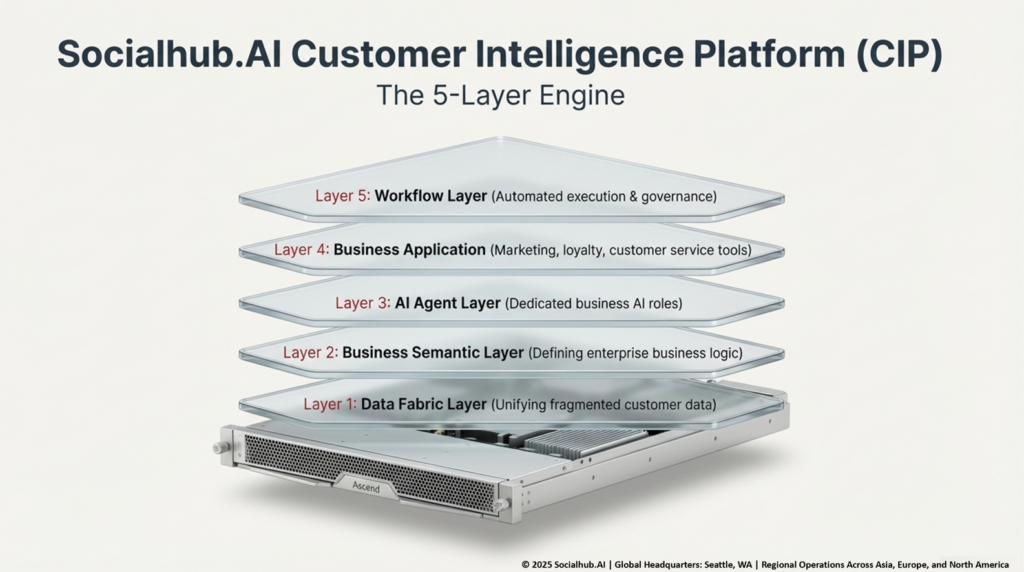
Layer 1: Data Fabric Layer — Unifying Fragmented Customer Data
The Data Fabric Layer is the foundation of Socialhub.AI’s CIP, breaking down silos by connecting e-commerce, POS, loyalty apps, social platforms, and in-store systems into a real-time, single source of truth. It eliminates duplicate records, resolves conflicting customer identities, and ensures every team works from the same accurate view of the shopper.
- Real-World Impact: For VF Corporation (a global apparel group with brands like Vans, The North Face, and Timberland), Socialhub.AI connected 12+ regional systems across Asia, creating a unified 360° view of 50M+ customers across 8 markets. This eliminated 92% of duplicate records, cut data reconciliation time by 80%, and laid the groundwork for coordinated pan-regional omnichannel campaigns that were previously impossible.
Layer 2: Business Semantic Layer — Translating Data into Retail Logic
The Business Semantic Layer translates raw data into retail-specific business logic, encoding rules for loyalty tiers, promotion eligibility, regional preferences, and compliance standards. This ensures AI and applications speak your brand’s language, not just technical jargon, aligning every automated action with your core business policies.
- Real-World Impact: A premium coffee chain used this layer to encode tiered reward logic (e.g., “Gold members receive free drinks on their birthday, but only in their home region”), ensuring all AI-driven offers and communications adhered to brand policy and regulatory requirements. This eliminated manual overrides and reduced compliance risks by 90%, while maintaining a consistent customer experience across markets.
Layer 3: AI Agent Layer — Deploying Dedicated Business AI Roles
The AI Agent Layer deploys specialized AI agents tailored to retail use cases: churn-prevention agents, personalized product recommenders, inventory optimizers, and customer sentiment analysts. These agents act on real-time customer signals to drive decisions at scale, delivering hyper-targeted engagement without manual intervention.
- Real-World Impact: A fast-fashion brand deployed a churn-prevention AI agent that identified at-risk customers based on purchase frequency, browsing behavior, and social sentiment. The agent triggered targeted win-back offers (e.g., exclusive discounts on favorite categories) that reduced customer attrition by 18% in 3 months, while preserving margin by avoiding blanket promotions.
Layer 4: Business Application Layer — Powering Omnichannel Tools with AI Insights
The Business Application Layer integrates with 50+ retail tools and channels (email, SMS, in-store kiosks, social media, and loyalty apps) to deliver AI-driven insights directly into core workflows. It powers marketing automation, loyalty management, and customer service tools, ensuring consistent, personalized experiences across every touchpoint.
- Real-World Impact: A global beauty brand used this layer to deliver product recommendations across email, in-app, and in-store kiosks, aligning offers with individual customer preferences and purchase history. This lifted cross-sell rates by 22% and average order value (AOV) by 15%, while reducing the time to launch personalized campaigns from 2 weeks to 48 hours.
Layer 5: Workflow Layer — Automating Execution & Governance
The Workflow Layer orchestrates end-to-end omnichannel workflows, automating campaign execution, data governance, and compliance checks. It eliminates manual tasks, ensures consistent customer interactions, and enforces regulatory requirements (e.g., data privacy, age restrictions) at scale.
- Real-World Impact: A regional grocery chain used this layer to automate promotion workflows, from triggering abandoned cart reminders to enforcing regional age restrictions on alcohol and tobacco products. This cut campaign launch time by 90% (from 2 weeks to 48 hours) and reduced human error by 90%, while maintaining full compliance with local data privacy laws.
The Retail Outcome: True Omnichannel That Drives Profit
For retailers leveraging Socialhub.AI’s CIP, the shift from CDP to CIP delivers tangible, measurable results:
- Seamless Customer Journeys: Shoppers receive consistent, personalized experiences across online, in-store, and social channels, building loyalty and reducing churn.
- Scalable Personalization: AI agents enable hyper-targeted engagement at a scale that was previously impossible with manual teams, driving higher conversion and AOV.
- Operational Efficiency: Automated workflows eliminate data wrangling and manual tasks, letting teams focus on strategy rather than repetitive work—reducing operational costs by up to 30%.
- Pan-Regional Alignment: Brands can coordinate global campaigns while respecting local market rules and preferences, unlocking growth across new regions.
These outcomes are already being realized by some of the world’s leading retail brands, including McDonald’s, Adidas, and VF Corporation, who use Socialhub.AI’s CIP to power their omnichannel strategies.
The Future of Retail Is AI-Native CIP
The move from CDP to CIP is not just a technological upgrade—it is a strategic imperative for retail. Legacy systems were built for a world of static data and batch processing, but modern shoppers demand real-time, personalized experiences at every touchpoint. Retailers that fail to adapt risk falling behind competitors who can turn data into intelligent action.
Socialhub.AI’s 5-layer CIP engine is the infrastructure that turns fragmented customer data into loyal customers and sustainable growth. It is the missing link between data collection and business impact, enabling retailers to finally deliver on the promise of omnichannel.
Ready to Transform Your Omnichannel Strategy?
If your retail brand is still relying on legacy CDPs or siloed systems to power your customer experience, it’s time to explore the future of retail with Socialhub.AI’s Customer Intelligence Platform. Our 5-layer engine is designed to solve the core challenges of omnichannel, turning data into actionable insights that drive profit and loyalty.
Visit socialhub.ai to learn more about our CIP architecture, explore case studies from leading retail brands, and schedule a demo to see how we can help you build a true omnichannel platform for the future.

Socialhub.AI | Powering the Next Generation of Retail Omnichannel
#RetailTech #Omnichannel #CustomerIntelligence #AIinRetail #EnterpriseAI #CDP #CIP
#SocialhubAI
- From Legacy CDP to AI-Native CIP: Reimagining Retail Omnichannel with Socialhub.AI’s 5-Layer Engine
- AI Strategy & Loyalty Roundtable Brings Industry Leaders Together at Microsoft Campus
- From Mass Promotions to Intelligent Decisions in Grocery Retail
- Why Loyalty and Promotions Fail in Restaurants — and How Customer Intelligence Changes the Game
- Why Fashion Brands Struggle with AI-Driven Growth — and What Customer Intelligence Platforms Change